
Rising Stone: A Vertically Integrated Alpine Compounder Trading at 4x 2028 Earnings
Ticker: ALRIS, Exchange: Euronext Paris

Quick pitch
Rising Stone is a perfect example of why we focus on small-caps: an underfollowed company with multiple structural advantages that make it a much higher quality business than its peers, yet trading at a lower valuation. Vertically integrated, founder-led, likely to triple net income over the next 3 years, yet trading at ~4x 2028 net income.
What do they do?
Rising Stone is a niche developer of ultra-luxury real estate in the heart of the French Alps, specializing in the design, construction, and operation of high-end properties in the most prestigious resorts.
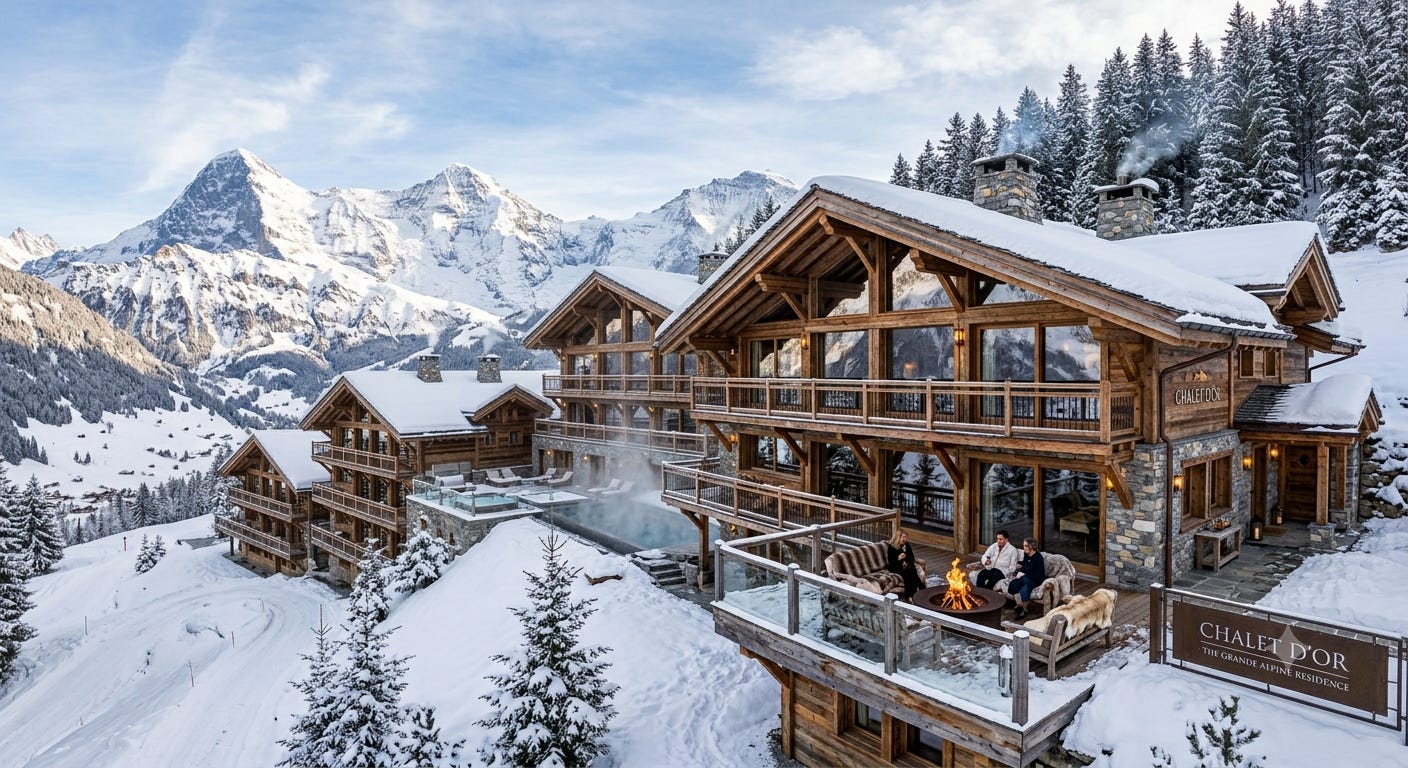
You can see all of their finished and upcoming projects on the company website.
We are very excited about this company because due to their small size and a very recent IPO, it is still almost undiscovered (zero mentions across X and Substack). Yet, we believe it won’t stay like that for long.
Why Is This a Good Business? Rising Stone Is Much More Than an Ordinary Homebuilder
The main competitive advantage lies in Rising Stone’s vertical integration. The company has in-housed the entire value chain – land acquisition, design, construction, project management, sales, and even recurring post-sale services like property management and luxury rentals.
Controlling every step gives them far better control over project execution and timelines. More importantly, it allows them to capture value at every layer rather than handing it off to third-party contractors. This shows up directly in their margins: in FY2025, Rising Stone delivered a 20.8% operating margin and a 14.2% net margin – in contrast to other French homebuilders that often barely get above 10% operating margin.
Beyond pure building capability, Rising Stone holds two crucial structural advantages: construction permits and land pipeline access.
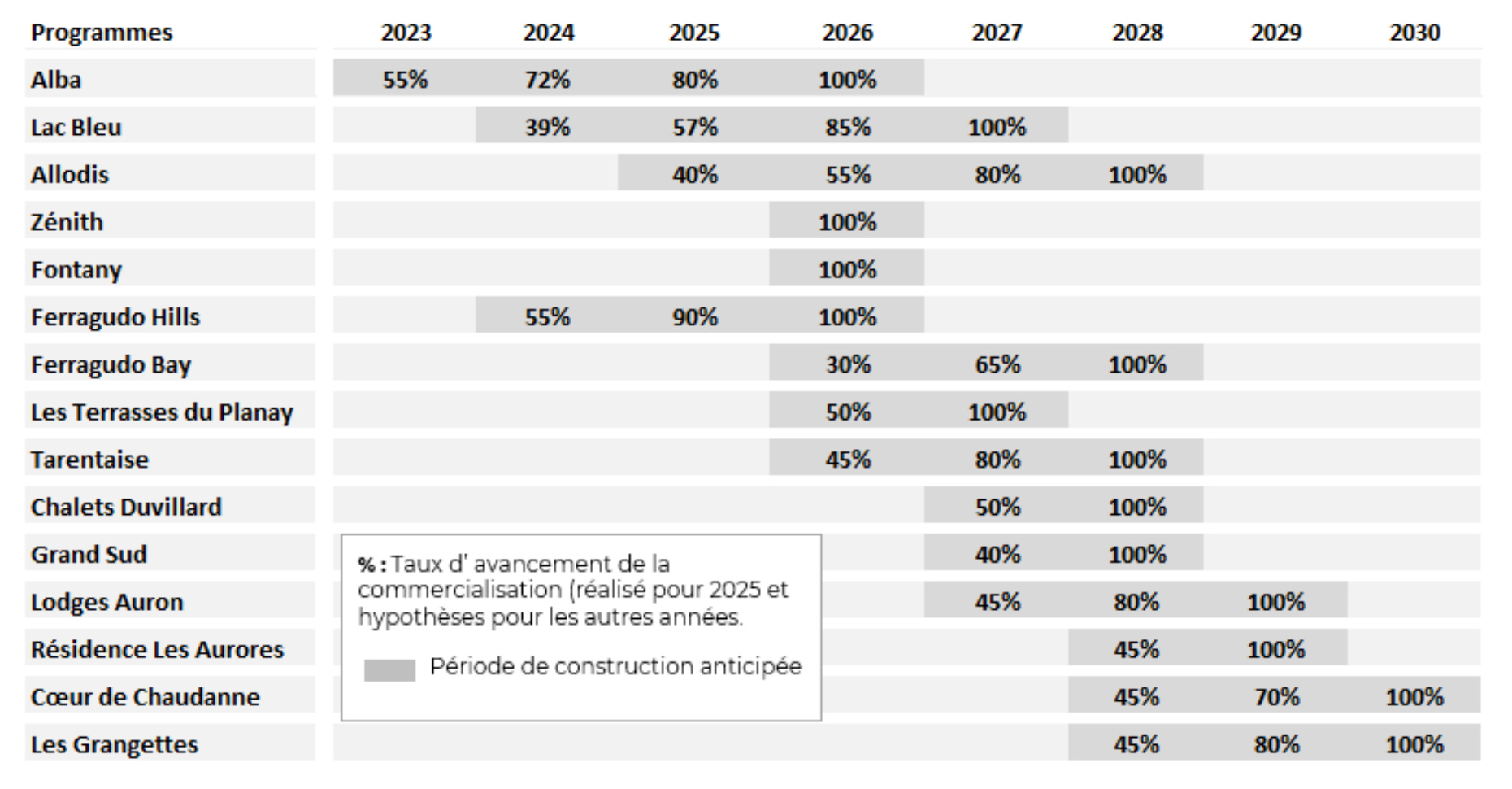
Raw land in top Alpine resorts is extremely scarce, and local urban planning rules (Plans Locaux d’Urbanisme) create massive barriers to entry. Yet Rising Stone holds a long-term development pipeline of roughly €1 billion in projected volume through 2030 in elite locations where competitors can barely get approvals.
A big reason for this is their standing with local authorities. Municipalities prefer working with Rising Stone because of their proven expertise and strong track record. On top of that, Rising Stone’s model of managing and renting out properties on behalf of owners keeps beds occupied, driving local tourism and tax revenue – something local mayors love to see when handing out scarce permits.
The company has also developed a unique capability in complex refurbishments. A great example is “Le Fontany” in Méribel-Mottaret, where they took an older, legacy building at 1,850 meters and completely retrofitted it into a high-efficiency ski-in/ski-out residence. This skill allows them to acquire prime legacy sites where new ground-up construction is blocked, while positioning them well to benefit from the upcoming wave of reconstructions that will be needed to comply with stricter French energy-efficiency regulations coming into force (more on this point later).
The company also differentiates in how it balances emotional “lifestyle” buying with institutional-level asset management for their clients. By designing properties to maximize rental yields and offering managed rental structures, they allow buyers to reclaim the 20% French VAT on new-builds and heavy renovations.
Finally, Rising Stone targets an ultra-high-net-worth clientele, making the business far less cyclical than standard residential construction. Demand for trophy real estate in top-tier, high-altitude resorts remains resilient regardless of broader economic cycles or mortgage rate spikes.
The €1B Backlog Gives Clear Visibility Through 2028 and Beyond
The key point of the investment thesis is Rising Stone’s project pipeline. The company currently manages 15 development projects representing ~€1 billion in total volume (of which ~€438 million is directly attributable to Rising Stone). We estimate Rising Stone is on track to generate ~2/3 of its market cap in net income just by finishing the current pipeline (most of it in the next 3 years). And that obviously excludes any new projects that will be launched in the future.
Based on the pipeline, the company gave sales guidance of €75M in 2026, €100M in 2027 and €155M in 2028 (reaffirmed in the latest earnings release). It is also important to note that management expects projects in pipeline will achieve even higher margins than past development (resulting in 19% net margin guidance for 2028).
Notably, demand for these properties is so large that pre-sales rates often exceed 50% before construction actually begins and 70% during the construction phase. This gives us confidence that there should be no issue on the demand side. However, given the significant leverage used in land purchases (20% equity, 80% debt), the main question is whether the company will be able to complete projects on time. Still, based on their solid track record and the progress of individual ongoing projects, we believe this should not be a large concern.
Structural Trends Driving Long-Term Growth
Growing HNWI Population
Global inequality continues to widen, and there’s little reason to expect a reversal in the medium term. This means a lot of wealth will keep concentrating at the very top of the distribution. The population of high-net-worth individuals (HNWIs) is projected to grow by roughly 28% by 2028. For a business selling ultra-prime real estate to this exact demographic, that’s a real structural tailwind.
A genuine supply crunch
The supply side of the Alpine luxury market is arguably even more compelling than the demand side.
Land scarcity is already showing up in prices. Between 2019 and 2024, property prices in Courchevel rose more than 70%, and in Méribel more than 40% – a reflection of just how little buildable land remains in the most desirable resorts.
Regulation is closing the door on new supply. France’s Zero Net Artificialization (ZAN) law effectively bans construction on virgin land by 2050. In practice, this puts a hard cap on the long-term inventory of new ski-in/ski-out property at existing developed land.
Climate change is shrinking the map of viable resorts. Rising temperatures mean the “snow line” – the altitude above which snow cover is reliable – is expected to climb to 1,600–1,800m by 2040–2050. Climate risk is concentrated at low- and mid-altitude resorts, many of which will struggle to guarantee a ski season within a couple of decades. This effectively shrinks the pool of resorts that can credibly market themselves as “snow-sure” over a multi-decade investment horizon.
Rising Stone’s portfolio is positioned squarely on the right side of this divide. Its properties sit at altitude in some of the highest resorts in the Alps:
Val Thorens: 2,300m
Val d’Isère: 1,850m+
Courchevel: 1,850m
Méribel: 1,450m (center)
On top of that, every resort in which Rising Stone operates has more than 50% artificial snow coverage – a further hedge against natural snowfall variability.
Put together, this means Rising Stone’s resorts are likely to be among the last standing with a reliable ski season as the snow line rises – a durable competitive moat that’s becoming more valuable with each passing decade.
The Catalyst: A Coming Wave of Regulations & Renovations
A large share of Alpine real estate was built decades ago – much of it in the 1960s–70s, with another wave tied to the 1992 Albertville Winter Olympics. That aging stock is now colliding with a steady tightening of energy and construction standards, creating a substantial and growing pipeline of renovation and restructuring opportunities.
The numbers here are striking: roughly 75% of mountain homes carry an F, G, or E energy rating (with F/G alone accounting for 38%). Under France’s Loi Climat et Résilience, that’s about to become a serious legal problem for owners, not just an environmental one:
Long-term rentals: G-rated buildings are banned from rental starting January 2025, F from January 2028, and E from January 2034.
Short-term/tourist rentals: newly registered tourist rentals rated F or G have already been excluded from the market since late 2024, E-rated properties lose their eligibility in 2028, and by 2034 every tourist rental (new or existing) must carry a rating between A and D.
In other words, roughly 75% of homes in these resorts will need to be renovated within the next eight years simply to remain legally rentable.
This plays directly into Rising Stone’s hands. Per management, Rising Stone is currently the only player able to deliver renovations at scale in an Alpine environment – a logistically difficult context (short construction seasons, altitude, restricted access, specialized labor) that has kept the renovation market fragmented and underserved. The 2030 Winter Olympics in the French Alps should act as a further accelerant, likely pulling forward investment and renovation activity across the region as it did around Albertville in 1992.
Renovation is also a structurally attractive business line in its own right: asset-light relative to ground-up development, with shorter project timelines and faster capital recycling.
And this ties back to the scarcity dynamic already discussed. As trophy land becomes harder to find and new construction becomes more constrained by ZAN and altitude economics, renovation of the existing stock becomes not just a nice-to-have adjacent business, but arguably the more important long-term growth lever. This is reflected in how Rising Stone is actually deploying its IPO proceeds: rather than funding the current development pipeline (for which 65% of the required land is already secured), the capital raised will be used for acquiring additional land for future projects and for scaling up the renovation business.
Community aspect adds another competitive advantage
We believe this is one of the most underapreciated aspects of the whole story. Thanks to the post-sale services offered to clients (property management, handling rentals, etc.) and a dedicated “Club Premium” (a community with events for clients, private investors, advisors, bankers, etc.), Rising Stone has successfully created a unique network of individuals. And it already gives them a significant competitive advantage:
„Referrals from existing clients are now a major driver of growth: over 50% of new sales come directly from recommendations provided by previous buyers. Thus, the Group’s client base constitutes a strategic asset with significant intangible value, combining brand awareness, trust, and network benefits. It allows Rising Stone to benefit from a steadily decreasing marginal acquisition cost and a powerful and sustainable growth lever.“
Valuation & Financials

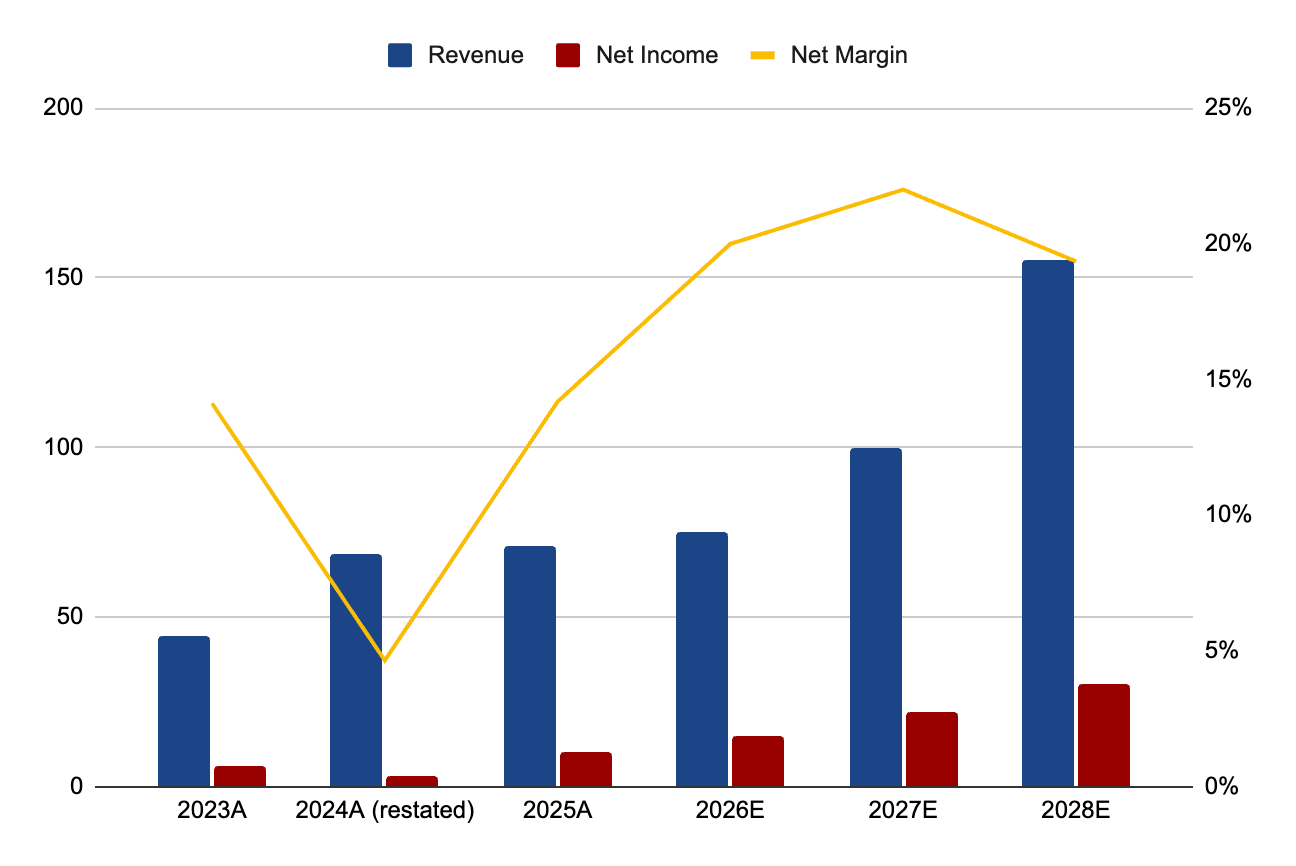
Looking at the future growth (which we consider achievable based on our analysis of the individual projects and their expected contributions) and margin profile, it is quite remarkable that the company is currently valued at a €130M market cap, representing a 9x P/E on this year’s expected earnings, and just 4.3x P/E on the 2028 base-case numbers.
To show how cheap that is, we did a quick comparison with other listed homebuilders (we took only those that are actually profitable). Clearly, almost all of them have much worse margins, barely grow at all, yet trade at higher valuations than Rising Stone. It is entirely possible Rising Stone could trade 50% higher just by re-rating to the same multiple as these peers. And we think that given its quality, it should actually trade at a premium – making us believe the company is significantly undervalued today.
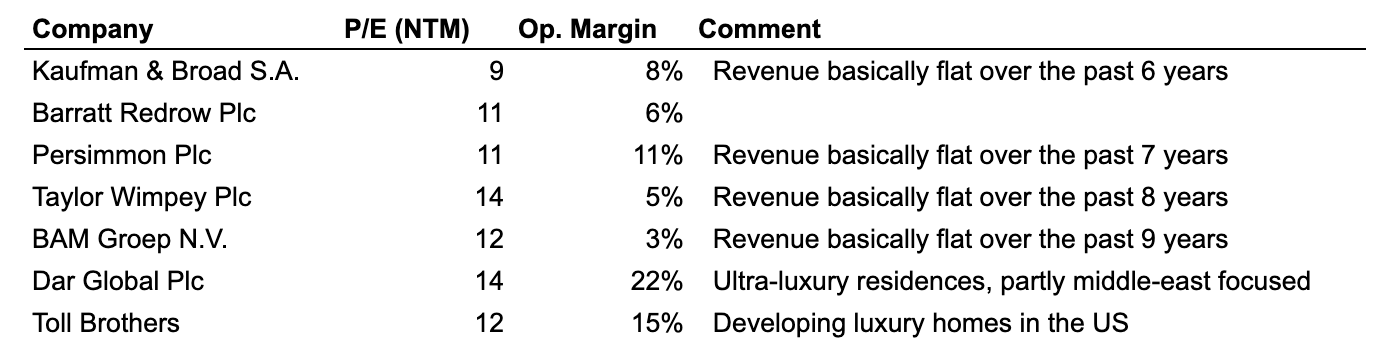
(Yes, we know that P/E is not a perfect measure for homebuilders, but it nicely shows just how much undervalued Rising Stone is. And on a completely unrelated note, look at the comment column – damn, running a homebuilder in Europe is hard…)
In addition, the company set out a policy of paying out 40% of profits as dividend. Currently, that amounts to a 3.1% dividend yield and if the forward guidance is met, that could grow to almost 10% yield on current purchase price in the coming years. Quite compelling.
Management & Incentives
The company is being led by its founder, Jean-Thomas Olano, who still owns 51% of the company.
Following the IPO, his renumeration changed to a very modest salary of 1,000 euros per month (nice move, reminds me of Mark Leonard) combined with bonuses tied to the company hitting the net income targets it set in its guidance. Olano must also keep at least 25% of any vested shares in registered form until he leaves his role. We do like this setup as it is much better than what is typical for small-caps and homebuilders in general. Unfortunately, this bonus scheme applies only to the CEO and not remaining management.
Return Scenarios
Even though we believe Rising Stone will be able to beat its guidance targets, we are conservative and use the guidance as our base case.
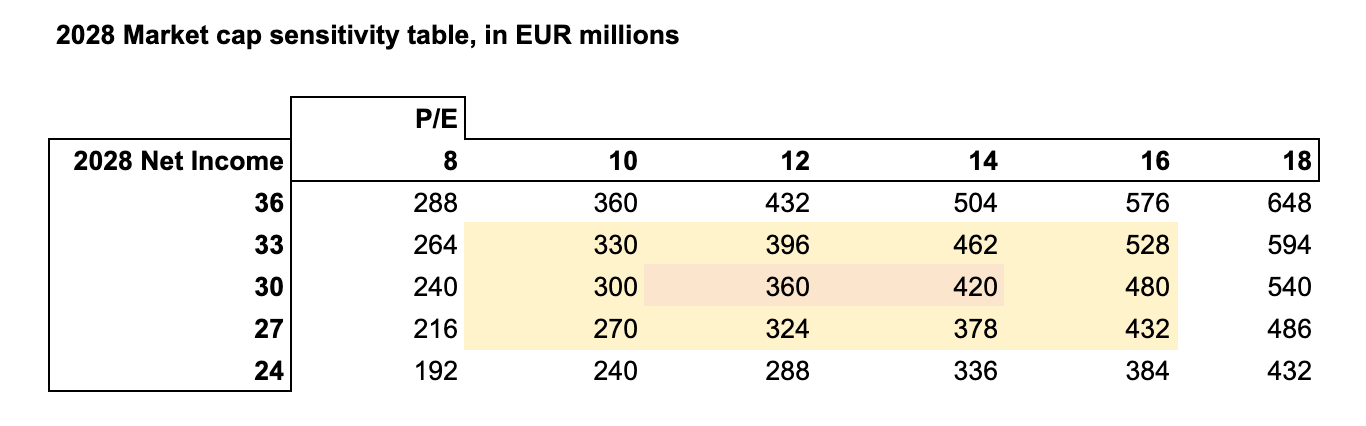
In the table below, you can see that even with zero multiple expansion (keeping the TTM P/E at the current value of 13), we get to a market cap of €390M representing a 3x return in less than 3 years and a 55% IRR. Taking the optimistic scenario of €33M net income, combined with a multiple expansion to P/E of 16, Rising Stone gets to a €528M market cap, representing a ~4x return (74% IRR). And that doesn’t even include the dividends paid out over the three years, which together could reach about 20% of current capitalization.
Conclusion
What we see in Rising Stone is our favorite setup and it shows why we focus on small-caps: the company is illiquid, still unknown (last time we checked there were zero mentions on X and Substack) and has an undemanding valuation, despite being poised to grow significantly in the coming years. We believe the market currently underappreciates all the characteristics and competitive advantages of the company that make it a much better business than its peers.
The opportunity exists because Rising Stone is yet too small for funds and institutions to enter, but it won’t be like that forever. As it grows closer towards the €300M market cap mark, we should start to see more institutional buying, price discovery, and multiple re-rating on top of the earnings growth itself. If that happens, the potential returns could be very attractive. And that’s why Rising Stone is one of our highest-conviction ideas today.
We are a Czech-based investment fund and research team focused on global small and mid-cap equities, compounders, and asymmetric opportunities.
Going forward, we’re planning to publish our detailed research, complete valuation models, portfolio updates, new positions, channel checks and multi-thousand-word investment theses here on our Substack. If you enjoy deep fundamental research on companies with compelling upside potential, we’d love to have you join us and subscribe for our future posts:
Disclaimer: This post is for informational purposes only and is not investment advice. It reflects the author's personal views and estimates, which may be incomplete or incorrect. Do your own research and consult a qualified advisor before making investment decisions. The author/affiliated fund currently holds a position in $ALRIS and may buy or sell shares at any time.
Thank you, interesting company
Hello, on headline numbers, looks like the founder's salary is EUR 1k per month, but there is a management services agreement with JTO Holdings, owned by the founder, which runs at EUR 750k per year. In addition, carpentry work for properties developed is subcontracted to another company owned by the founder, which cost Rising Stone ~2.2mm in FY25. Any thoughts on these related party transactions?