
Arrow Exploration: Our Favorite Way to Play High Oil Prices with a 40%+ FCF Yield
Ticker: $AXL, Exchanges: LSE, TSXV

Quick pitch
Arrow Exploration is a profitable, debt-free Colombian oil producer that trades at a market cap barely above its net cash plus the next two years of expected free cash flow. With essentially no hedging, every dollar of Brent flows almost straight through to the bottom line – directly benefiting from recent oil price shocks. Large cash position, 40%+ FCF yield and multiple catalysts with significant upside potential on top. And the single biggest overhang on the stock just took a real step toward resolution with Colombia's recent election.
What do they do?
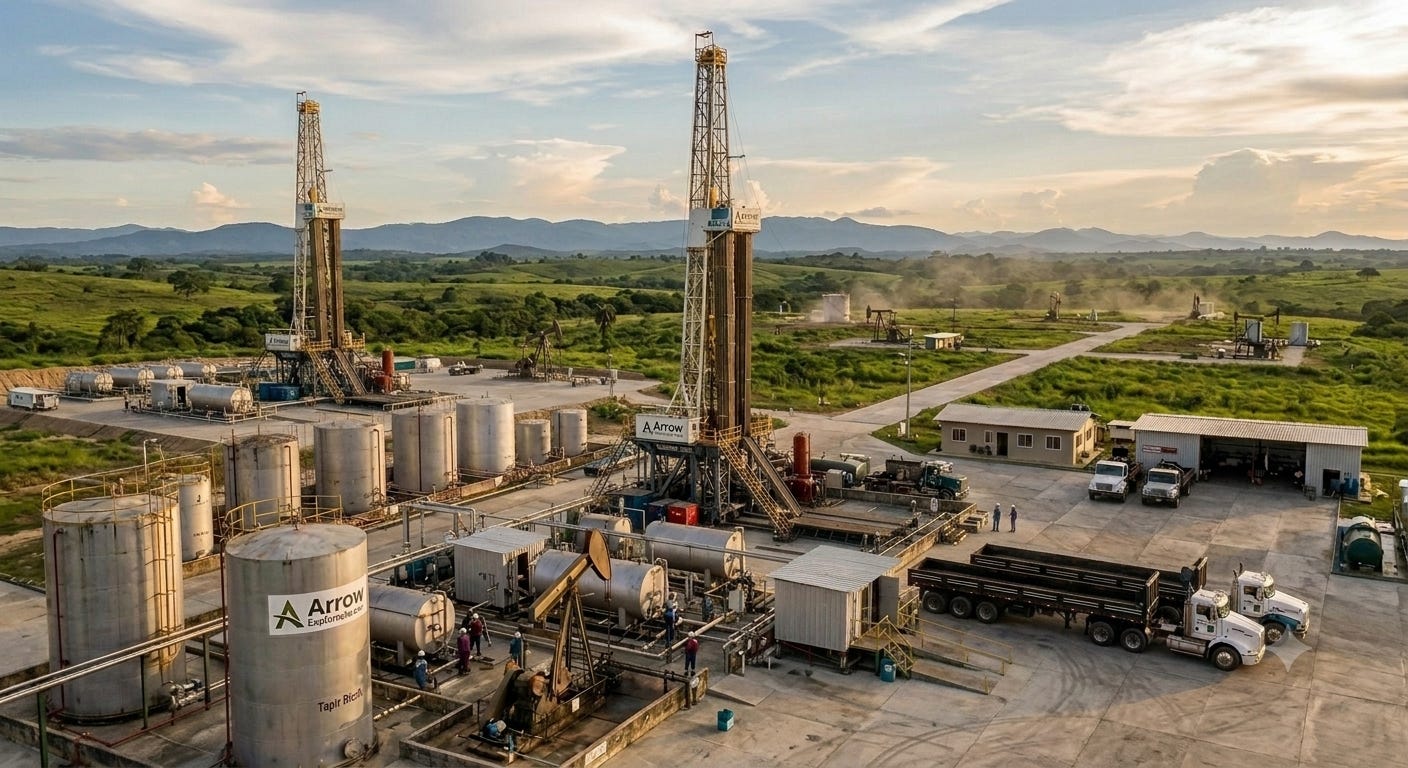
Arrow is a junior oil & gas producer focused on Colombia’s Llanos Basin, where its flagship asset, the Tapir Block, generates the large majority of production and cash flow, alongside a much smaller legacy asset base in Western Canada. Current production runs roughly 5,000–5,500 boe/d, of which more than 95% is oil. That last detail matters: unlike many small producers whose economics get muddied by weak natural gas pricing, Arrow’s story is almost entirely a clean bet on the price of oil with multiple upside catalysts on top.
Why Arrow Is the Purest Way to Play Higher Oil Prices
Most producers hedge a portion of future production, capping their downside but also giving away much of the upside when prices rise. Arrow does the opposite – it runs with essentially no meaningful hedging book, so almost every incremental dollar of Brent drops straight into cash flow.
A few numbers that show just how much leverage that creates:
Per Hannam & Partners, each additional $1/bbl of Brent adds roughly $1.9M to Arrow’s annual EBITDA. At current production of 5,000–6,000 bbl/d, that’s a meaningful swing for a company of this size.
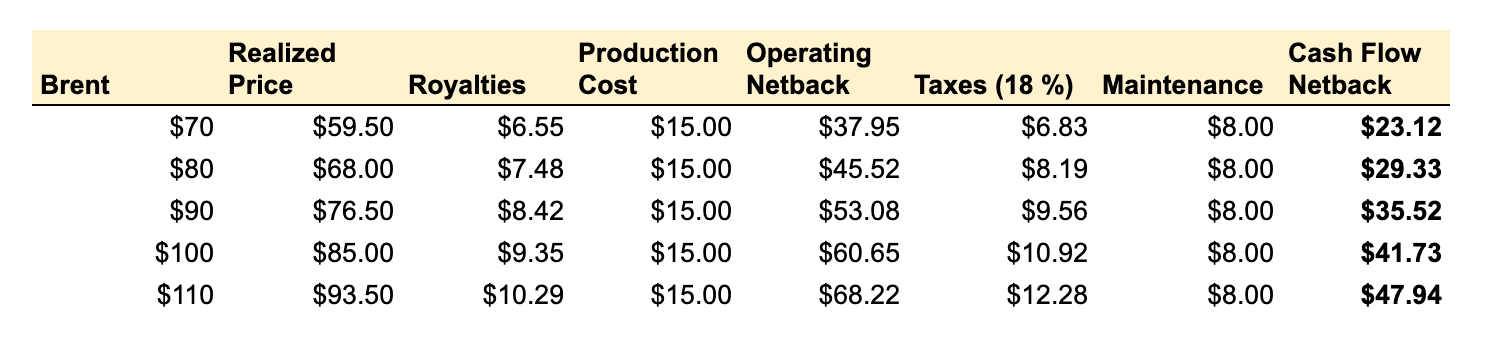
Operating netback (operating profit per barrel) currently runs around $35–40/boe at Brent in the $70–80 range – a large share of every incremental oil dollar ends up as operating profit rather than being eaten by costs.
The company holds net cash of $27M (we estimate it is already around $35M today) and no debt, which means virtually all of that operating leverage flows to equity holders rather than lenders.
To make the leverage concrete, here’s a sensitivity analysis we ran showing the impact of different oil prices and current cost structure on Arrow’s cash flow netback (basically OCF per barrel):
Multiplying that with the expected production this year (about 5,000–5,500 boe/d), we arrive at the operating cash flow Arrow might generate annually:
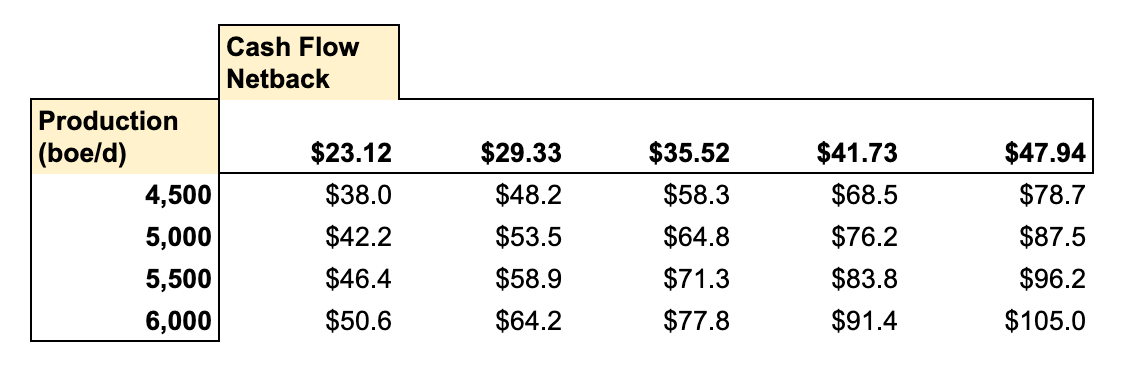
Even after subtracting $24M for capex (company guidance for this year), Arrow is on track to generate over $40M of FCF this year. And the market is currently valuing the whole company at just around $100M.
So, to sum it up, Arrow today has a $100M Market Cap, ~$35M of cash, no debt, and is on track to generate over 40% of its market cap in FCF just this year.
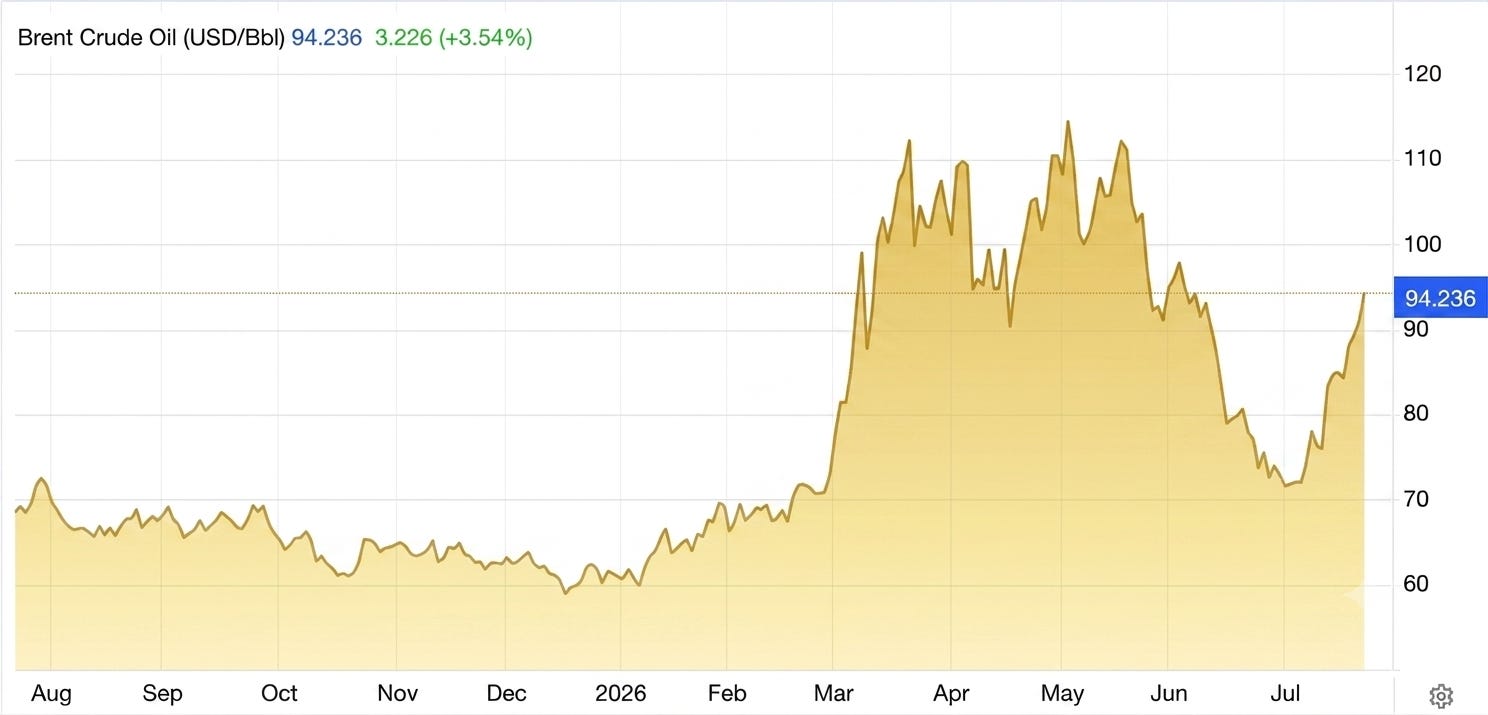
Even at Brent $70 – well below where oil has traded for much of the past year – Arrow could generate almost 20% of its current market cap in free cash flow – that is a remarkable amount of cash generation relative to the price being asked for the equity today.
Three Reasons the Market Hates Arrow – And Where’s the Opportunity
We think there are three main reasons Arrow trades where it does:
Size. With a market cap around $100M, it sits below the radar of most institutional investors entirely.
A blanket Latin America discount. Many investors apply a generic risk discount to anything domiciled in the region without digging into the specifics of the situation.
The Tapir license. This is the big one. Tapir hosts the heart of Arrow’s production, but the current license expires in early 2028, and part of the market fears it simply won’t be renewed.
That third point is legitimate on the surface, but it looks considerably less scary once you dig in:
Management continues to invest tens of millions of dollars into new wells and infrastructure at Tapir. That kind of ongoing capital commitment would make little economic sense if leadership genuinely believed renewal was unlikely.
The political backdrop is shifting. A rightward political wave has been moving through Latin America (Argentina under Javier Milei being the clearest example), and Colombia was next in line for elections.
That election has now happened. In June 2026, right-wing candidate Abelardo de la Espriella narrowly won Colombia’s presidential runoff, ending four years of Gustavo Petro’s leftist, anti-hydrocarbon government. De la Espriella has campaigned explicitly on reopening oil and gas exploration, reversing Petro’s moratorium on new hydrocarbon contracts, and pushing Colombia’s national oil production sharply higher.
HFI Research wrote a great writeup about the current developments, fittingly named “Investors Are Underappreciating How Positive Espriella Will Be For The Colombian Energy Sector“. You can read it here:

Notably, they conclude:
“Now that the old president is gone, Ecopetrol will embark on a new era of exploration and deal-making. There are 4 years of pent-up demand for deals that have been sitting in the back office, cluttered by bureaucracy. For the sake of due diligence, we have hired on-the-ground political consultants to inform us about the labyrinth we need to navigate in such a hostile political environment, and let me just say that it is more torturous than poking your own eyes with needles.
Under Espriella, his campaign was pro-hydrocarbons. He wants to restart oil and gas exploration, something Petro banned. He wants to issue new contracts, allow responsible fracking, offshore Caribbean oil and gas, and push Ecopetrol’s reserves higher. He stated in his campaign that he wants to push Colombian oil production from ~734k boe/d to 1.35 million boe/d. That’s not possible without the support of other operators.”
And we agree with this take.
Of course, a change like this doesn’t guarantee Tapir gets extended – but it meaningfully improves the odds, and removing even part of the political discount currently baked into the share price could re-rate the stock by a large margin, independent of anything happening to the oil price itself.
Arrow’s management has repeatedly stated that they believe the license extension should happen later this year following the elections. We think this matters a lot, because it’s a genuine one-off catalyst that’s largely disconnected from macro factors. If Tapir is extended on the terms we’d expect (likely a 5+5 year structure) we could easily see that news alone driving the stock 30–50% higher on its own.
There’s also a second-order angle worth noting: the new government wants to reverse Colombia’s oil production decline, and Ecopetrol – the inefficiently run state producer – is reportedly being pushed to collaborate more with private operators and offload licenses it isn’t using. Given Arrow’s strong balance sheet and cash reserves, it could be well placed to acquire additional attractive assets if that plays out.
Now, let’s look at the few “call options” that are associated with the company and that we think the market largely overlooks.
The Free Call Option Number One: Icaco
Beyond the license and the oil-price leverage, Arrow holds real exploration upside through its Icaco discovery, which has meaningfully changed the investment picture over the past several months. Initial results showed oil present across multiple formations at once, and subsequent flow tests came in well ahead of expectations. Management has since spudded a follow-up well, Icaco-2, aimed at establishing the true size of the discovery.
Several covering analyst houses raised their price targets after the initial results – Auctus Advisors, for example, has pushed its target as high as 50 pence per share post-Icaco. Longer term, management has talked about growing total production toward 10,000 bopd, roughly double current output. If Arrow gets anywhere close to that, the cash flow math we shown above essentially doubles.
This is connected to another important point of the thesis. The market is still worried that shareholders will never see the generated free cash flow due to high CapEx. However, we believe that higher oil prices and more favorable conditions in Colombia make it much more likely today that management will hit its target of around 10,000 barrels per day of production. And they have repeatedly stated that once they reach this level, the company doesn't want to grow any further. At that point, the priority will shift to buybacks and dividends – returning all excess cash to shareholders.
Downside Protection: Even the Bear Case Isn’t a Zero
The nice thing about this setup is that the pessimistic scenario still isn’t a wipeout. Assume Tapir simply isn’t extended and production begins declining as the license approaches its 2028 expiry, with no further exploration success and no growth. Even in that world, Arrow is already generating substantial cash flow today, and our estimates suggest the company could still accumulate roughly $70–80M of net cash by 2028 after CapEx – a figure that’s remarkably close to today’s entire enterprise value of the company.
In other words, a meaningful chunk of value gets created here even before the license question is resolved one way or the other, purely from cash the business throws off in the meantime.
What the Analysts Say
It’s notable that essentially every analyst house covering Arrow currently sees fair value well above where the stock trades:
Hannam & Partners: risk-adjusted NAV of roughly 41p/share
Zeus Capital: around 35p/share
Auctus Advisors: raised to as high as 50p/share following the Icaco results
That implies upside in the range of roughly 50–100%+ relative to the prices at which these targets were published – and importantly, most of these models still use fairly conservative assumptions. They don’t fully credit a scenario of sustained high oil prices, further exploration success, or more aggressive production growth toward management’s 10,000 bopd target.
The Free Call Option Number Two: Geopolitics
On top of the base thesis, Arrow also happens to be one of the better-positioned small producers if tensions around the Strait of Hormuz continue to escalate (what sadly seems to be the case these days). Roughly a fifth of global oil consumption transits that corridor, and any disruption tends to push Brent sharply higher, even if only temporarily. Because Arrow carries no meaningful hedging, it would capture almost the full benefit of such a spike, unlike larger producers who have locked in forward prices and would only partially participate.
We’re not trying to predict macro events and are not basing the thesis on a Hormuz disruption – but it’s a real, underpriced call option sitting on top of an already-cheap, already-cash-generative business.
Risks
No investment is without risk, and this one has a few worth being direct about:
A sustained decline in oil prices
Non-renewal of the Tapir license
Weaker-than-expected results from exploration wells
Low liquidity and wide bid/ask spreads typical of a thinly traded small-cap
Political instability in Colombia more broadly
Natural production decline at existing fields, which requires continuous reinvestment to offset
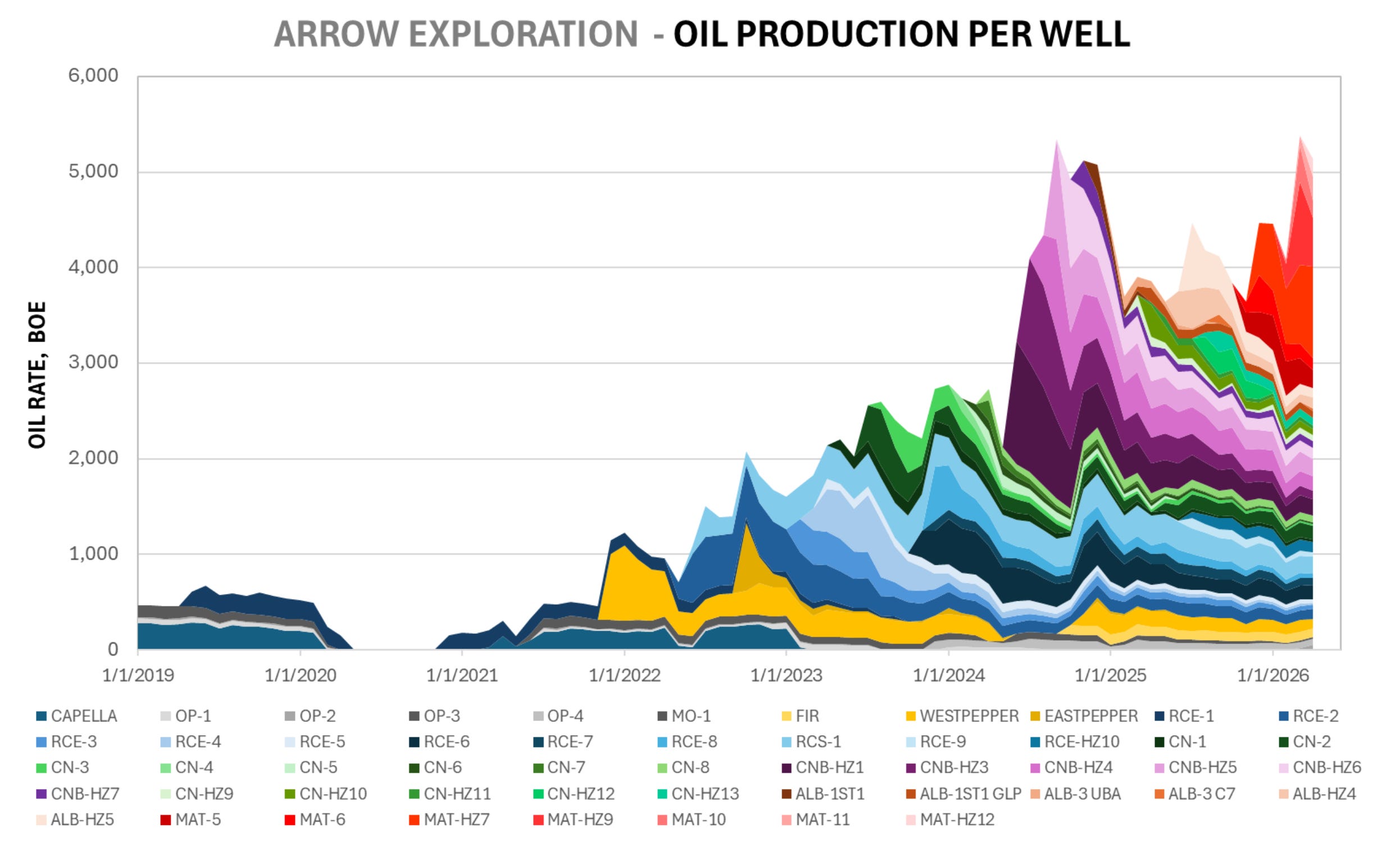
That last point matters: Arrow isn’t a business with a decade of guaranteed flat production. It has to keep drilling to maintain and grow output (production per well shown below for illustration). The offsetting factor is that at current oil prices, the returns on that reinvestment are strong enough that it can all be funded from internally generated cash flow, without needing to raise external capital.
Conclusion
Arrow Exploration is one of the most interesting asymmetric setups we’ve come across in the energy sector. The market remains focused on political risk, the Tapir license, and a general dislike of small oil producers. What it’s overlooking is a company that generates exceptional cash flow, carries essentially no hedging, benefits directly from every move higher in oil prices, holds a strong net-cash balance sheet, has real exploration catalysts in front of it, and trades well below the fair value estimates of the analysts who actually cover it (including us).
If none of the positive catalysts play out, we think the current valuation already offers meaningful downside protection through cash generation alone. If even some of them do – higher oil prices, a Tapir extension, further Icaco success – the re-rating potential could be a multiple of where the stock sits today.
We are a Czech-based investment fund and research team focused on global small and mid-cap equities, compounders, and asymmetric opportunities.
Going forward, we’re planning to publish our detailed research, complete valuation models, portfolio updates, new positions, channel checks and multi-thousand-word investment theses here on our Substack. If you enjoy deep fundamental research on companies with compelling upside potential, we’d love to have you join us and subscribe for our future posts:
Disclaimer: This post is for informational purposes only and is not investment advice. It reflects the author’s personal views and estimates, which may be incomplete or incorrect. Do your own research and consult a qualified advisor before making investment decisions. The author/affiliated fund currently holds a position in $AXL.V and may buy or sell shares at any time.